Charter Cities and Legal Imperialism: Honduras on the Frontline
Abstract
Charter cities promise development through imported law, investor-friendly governance, and economic efficiency. Yet in Honduras, this promise has culminated in an almost USD 11 billion arbitration claim that threatens national sovereignty itself. By tracing the rise and legal unravelling of Próspera, this piece asks whether charter cities are a genuine development tool or a modern reincarnation of treaty ports. As Honduras faces off against investors before ICSID, the case exposes how international investment law may be reviving extraterritorial rule under a new name, placing the Global South once again on the frontline of legal imperialism.
I. Introduction
The application of the law as we understand it today is heavily related to the idea of jurisdiction, particularly territorial jurisdiction. This was not always the case. During the Middle Ages and most of the early modern period, legal authority was not determined solely by where someone was located. Different legal orders generally coexisted, and people were subjected to different rules depending on their status, activities or specialised norms. With the rise of nationalism in the 19th century, jurisdiction began to be closely associated with State sovereignty and, therefore, territory. Nevertheless, jurisdiction beyond States’ borders still existed. Throughout the 19th century, extraterritorial jurisdiction was used as a means for European powers and the U.S to exercise authority in foreign legal systems. Clear examples of this were treaty ports in China and Japan, where foreign traders were subjected to the laws of their home countries rather than those of the host State. This form of extraterritoriality is widely regarded by scholars as a form of colonialism, and many have expressed concerns that the current model of International Investment Law (IIL) contains traces of this colonial legacy.
While the colonial roots of IIL have largely been discussed by academics, a newer concept has emerged that could further support such critical views. Charter cities were first introduced in 2009 by Nobel Laureate Paul Romer in a Ted talk in Oxford, he advocated for the creation of cities that function under a charter. The charter sets out the city’s rules, particularly investor-friendly ones, often directly transplanted from developed economies in what he called partnerships with foreign countries. While advocates emphasise on the economic potential for countries willing to adopt them, it is clear that charter cities bear a significant resemblance to treaty ports. Romer, alongside various economists and investors, then pitched this idea to developing economies, with Honduras becoming the first one to amend its constitution in 2011 to allow for their creation. 12 years later, Honduras is facing an investment claim before an ICSID tribunal for almost 11 billion dollars on compensation related to their chartered city “Próspera”, an amount equivalent to roughly 16% of the nation’s 2024 GDP. This short essay examines the circumstances that paved the way for the creation of Próspera, how the legal dispute has unfolded so far, and the potential implications that charter cities may have as a new instrument of legal imperialism under IIL.
II. Prelude of a Conflict Foretold
The way in which charter cities and Próspera were legitimised should have raised concerns among civil society and investors. The project was promoted by a handful of key political figures who would later become embroiled in criminal allegations. The project was promoted primarily by conservative president Porfirio Lobo Sosa (2009 – 2014), who came to power immediately after a coup d’etat against former left-wing president Manuel Zelaya. Another key figure involved in the planning of Honduras’ charter cities was Juan Orlando Hernández, then president of the National Congress, who would go on to succeed Lobo Sosa as president (2014 – 2022). Lobo Sosa would later be prosecuted for diverting public funds between 2010 and 2013, and Orlando Hernández would be arrested and extradited to the U.S on drug trafficking charges in 2024.
In addition to charters cities being promoted by politicians who came to power in an undemocratic way and were later prosecuted, there were also significant irregularities throughout the legislative process. In 2011, Congress passed a constitutional amendment allowing the creation of Special Development Regions (REDs) by a 126 – 1 vote. The REDs law enabled these cities to operate under their own administrative system, enact their own law and function under their own jurisdiction. In 2012, the Supreme Court of Honduras declared this law unconstitutional, primarily because it sought to amend parts of the constitution that could not be amended, such as provisions prohibiting the concession of national territory in ways that harm national integrity and sovereignty. Shortly after the judgement, the judges who voted against the REDs were removed from office by President Lobo Sosa.
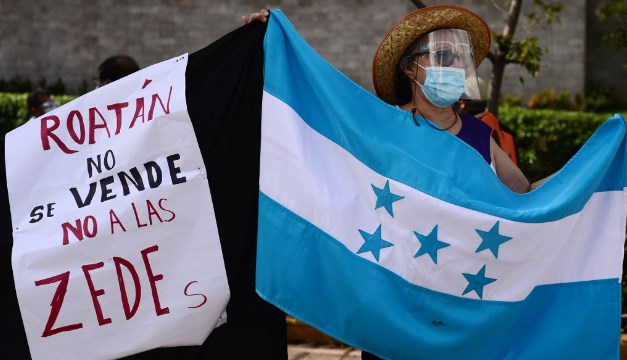
In 2013, Congress adopted a new constitutional amendment followed by an enabling law which allowed the creation of Zones for Employment and Economic Development (ZEDEs). These zones followed the REDs framework while attempting to address the constitutional previously raised. In 2017, three ZEDEs were established, Próspera being the most ambitious of them. In 2021, Xiomara Castro, the wife of the overthrown president Manuel Zelaya, was elected president, campaigning heavily on repealing the ZEDEs law. In 2022, President Castro effectively repealed the law.
III. All – Out Legal War
In December 2022, after the repeal of the ZEDEs law, Honduras Próspera LLC and John’s Bay Development Company LLC – both companies incorporated under the laws of Delaware - initiated arbitral proceedings before the International Centre for Settlement of Investment Disputes (ICSID). They alleged that Honduras’ actions constituted a violation of the Most Favoured Nation (MFN) provision contained in both the Free Trade Agreement between Central America, the Dominican Republic, and the United States of America (CAFTA-DR) and the Agreement for Legal Stability and Investor Protection concluded between Honduras Próspera and Honduras (LSA).
However, the tribunal has not yet decided on the substance of the dispute. Honduras raised a preliminary objection, arguing that the tribunal lacks jurisdiction since the claimants failed to exhaust local remedies, which are an explicit prerequisite to arbitrating a dispute under Honduran foreign investment law. The claimants responded by posing three main arguments: 1) Honduras has incorrectly categorised the objection as a matter of jurisdiction, when in fact it represents a matter of admissibility; 2) the exhaustion requirement does not suffice as a barrier of jurisdiction; and 3) even if exhaustion of local remedies were required, doing so would have been futile.
Rightfully, the first argument was quickly disregarded by the Tribunal. The categorisation of a preliminary objection as a matter of admissibility or jurisdiction allows for an extensive scholarly debate and may have pivotal effects later in the proceedings, but also imposes an unnecessary burden on tribunals and risks overcomplicating an already complex issue. The tribunal concluded that such a distinction was not decisive here as CAFTA-DR grants them a broad mandate to entertain any kind of objections, including admissibility or jurisdiction.
The preliminary phase focused mostly on the second and third arguments, which ultimately persuaded the tribunal. Regarding the second argument, the tribunal found that Honduras waived the requirement to exhaust local remedies. The tribunal reached this conclusion by interpreting CAFTA-DR Article 10.18.2, which requires investors to renounce their right to initiate local proceedings before proceeding to arbitration. The tribunal further indicated that, even if they were to disagree with the second argument, they would still find that exhausting local remedies in this case would be futile. Their reasoning lies on the fact that, even if the claimants were to appeal to the Honduran Supreme Court, the highest judicial body, they could only request a review of the constitutionality of the repeal of the ZEDEs law. However, the Supreme Court has already reviewed this constitutionality and found it to be constitutional.
Therefore, the tribunal has rejected Honduras’ preliminary objections and is now prepared to move on to the merits of the case.
IV. Honduras’ First line of defence failed, now what?
Not everything is lost; Honduras still needs to build its arguments on the merits of the case. It would have to demonstrate that, by repealing the ZEDEs law, it acted in accordance with CAFTA-DR and LSA, which both contain not only MFN provisions, which the claimant already expressed their intention on invoking, but also provisions like Fair and Equitable Treatment and expropriation. Moreover, in late 2024, two more multinationals filed claims against Honduras alleging that the repeal of the ZEDEs law violated international obligations owed.
Beyond this legal skirmish, it is important to consider the political aftermath of the lawsuit. At the time of writing, Honduras is on the verge of electing a new president on 30th November 2025, where two candidates are leading the polls: Rixi Moncada, a left-wing candidate endorsed by current President Castro, and Nasry Asfura, representing the party of former Presidents Lobo Sosa and Orlando Hernández. While he has not made a public announcement yet, Asfura would most likely continue with the ZEDEs project promoted by his predecessors. Additionally, U.S President Donald Trump has openly endorsed Asfura, stating that if he wins, he would pardon former President Orlando Hernández; but in case of defeat, he would cut aid to Honduras. This is a striking position considering the active stance and threats against other countries of the region over drug-trafficking accusations, particularly against Venezuela.
V. A word of caution for Host States of the Global South
Having examined the outcome that the first charter city so far, is fair to ask: are charter cities another form of legal imperialism, or could they be considered a genuine vehicle to accelerate economic development? Just as the IIL regime has faced numerous criticisms concerning State sovereignty and the colonial roots of the system, charter cities appear to follow suit. Many States, particularly in the Global South, have already considered experimenting with charter cities. Honduras shall serve as the primary example of how damaging charter cities can be, with lawsuits demanding exorbitant sums against countries with political instability and weak rule of law.
As such, in this constant struggle between States of the Global South and multinationals from developed economies, Honduras stands on the frontline. If Próspera wins, we may be witnessing the spread of neo-treaty ports, now to a larger extent. If Honduras prevails, the Global South may finally be drawing a line against legal imperialism. In the years to come, the future of our understanding of sovereignty will be on trial.
Bibliography
In Shaunnagh Dorsett and Shaun McVeigh, ‘Authority and Authorisation: Sovereignty, Territory, Jurisdiction’ in Jurisdiction (Routledge 2012) 96 – 111
Jullia Lovell, Opium Wars: Drugs, Dreams and the Making of China (Picador 2012) 161 – 163
Linarelli, John, Margot E Salomon, and Muthucumaraswamy Sornarajah, 'Foreign Investment: Property, Contract, and Protecting Private Power', in The Misery of International Law: Confrontations with Injustice in the Global Economy (Oxford, 2018; online edn, Oxford Academic, May 2018) 159 – 162
Paul Romer, ‘Paul Romer’s radical idea: Statute Cities’ (YouTube, August 5th, 2009) https://www.youtube.com/watch?v=mSHBma0Ithk
Paul Romer, ‘Technologies, Rules, and Progress: The Case for Charter Cities’ (2010) Centre for Global Development 9
Paul Romer, ‘Paul Romer: The World’s first chartered city?’ (YouTube, June 9th, 2011) <https://www.youtube.com/watch?v=mSHBma0Ithk>
Emily Tian, ‘US Sanctions Ex Honduran President and First Lady over Alleged Graft’ (OCCRP, 20 July 2021) <https://www.occrp.org/en/news/us-sanctions-ex-honduran-president-and-first-lady-over-alleged-graft>
Nicholas Biase and Victoria Bosah, ‘Juan Orlando Hernandez, Former President Of Honduras, Extradited To The United States On Drug-Trafficking And Firearms Charges’ (DOJ, 21 April 2022) <https://www.justice.gov/usao-sdny/pr/juan-orlando-hernandez-former-president-honduras-extradited-united states-drug>
Estatuto Constitucional de las Regiones Especiales de Desarrollo (RED) (Honduras, 23 June 2011), Article 4
Image: 'El Mundo' https://diario.elmundo.sv/ampArticle/honduras-crecen-las-protestas-contra-el-plan-de-creacion-de-las-zonas-de-empleo-y-desarrollo-economico?amp=1